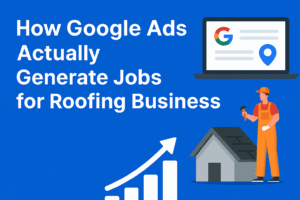
Google Ads has become one of the most competitive spaces in digital marketing. But here’s the good news: when done right, Google Ads can help roofing companies consistently generate high-quality leads, land more projects, and scale profitably.
Compared to platforms like Facebook, where people are just scrolling and not actively looking for a roofer, Google Ads works differently. Here, your customers are searching with high intent. Someone typing “roof replacement near me” or “emergency roofer in Dallas” is ready to buy—not just browsing.
That’s why roofing companies see quicker results (often in the first 4 weeks), benefit from precise targeting (specific services + locations), and can measure ROI easily. Plus, the customer lifetime value in roofing is high—so one closed job pays for weeks of ads.
But here’s the reality: running Google Ads is not just about creating a campaign and waiting for leads. You need a proper system—built on three main pillars:
- Google Ads Management & Tracking
- Landing Pages
- Sales Funnel
Best Google Ad Types for Roofing Companies
Before we dive into the system, let’s make one thing clear: there are two main types of ads you can run for roofing businesses.
Google Local Services Ads (LSAs)
LSAs are powerful because they generate leads at a very low cost per lead. To use them, you’ll need:
A verified Google My Business profile
An LSA account setup
Certifications and identity verification
The challenge with LSAs is inconsistency. Some months you’ll get plenty of leads, while others you may get none. You don’t have full control over how consistent your pipeline is, which is risky if you’re relying on it as your main source of leads.
Standard Google Ads (PPC)
On the other hand, with standard Google Ads, you have more control. You can run different types of campaigns targeting customers at different stages of the sales funnel. But for roofing businesses, the most important and effective campaign type is Google Search Ads — because you’re reaching people actively searching for roofing services right now.
Let’s break it down step by step.
1. Google Ads Management & Tracking
Setting up your Google Ads account is simple: create an account, complete business verification, and you’re ready to go. But roofing companies don’t want vanity clicks or top-of-funnel traffic. They want direct bottom-of-the-funnel leads—people ready to book a call or request a quote.
And the best way to do this is through Google Search Ads.
Campaign Structure
Think of it like this:
- Campaign → “Roofing Services”
- Ad Group 1: Roof replacements
- Ad Group 2: Roof repairs
- Ad Group 3: Flat roofs
- Ad Group 4: Location-based (e.g., “roofers in Houston”)
- Ad Group 1: Roof replacements
This separation gives you better CTR and Quality Scores, because each ad is tightly aligned to the keyword and searcher intent.
If you serve multiple areas, build separate ad groups—or even separate campaigns if budget allows.
Keywords
Keywords are the backbone of your campaign. To succeed, you should group them into buckets:
- Service-specific: “roof replacement,” “roof leak repair”
- Location-specific: “roofer London,” “roofing company Dallas”
- Generic intent-based: “best roofing contractor near me”
Just as important are negative keywords. Exclude searches like DIY roofing, competitor names, or just “roof materials.” These clicks won’t turn into jobs.
(Pro tip: use Google Keyword Planner to see search volumes and refine your targeting.)
Settings & Bidding
- Goal: Sales (not clicks or awareness)
- Network: Search only (exclude Display/Search Partners)
- Location targeting: Use a radius around service areas
- Bidding: Start with Manual CPC, then once you have enough data, switch to Max Conversions.
Ad Copy
Remember: your ad’s job is to get the click, not close the sale.
Best practices:
- Use dynamic keyword insertion to boost relevance.
- Highlight unique trust factors: “No callout fees,” “Same-day site visit,” “250+ 5-star reviews.”
- CTR benchmarks: location-based keywords → 8–10%+, cost-based keywords → 15–18%.
Tracking
This is where many roofing companies fail. You can’t optimize what you don’t track.
I recommend setting up Google Tag Manager to track:
- Form submissions (quote requests, consultations)
- Phone calls (only count calls that last at least 60 seconds)
- Bookings made through the website
In Google Ads, set primary conversions (form submits, qualified calls) separate from secondary conversions (button clicks, other engagements). Google will then optimize only for what truly matters—leads that close.
And for deeper tracking, I personally use WhatConverts. It captures all leads, integrates with Google Ads, and even shows call transcriptions so you know exactly what customers asked about.
2. Landing Pages (40% of Results)
Your landing page is just as important as your ads. In fact, it can influence up to 40% of your ad results.
Here’s what every roofing landing page needs:
- Trust-building elements: before-and-after photos, Google reviews, social proof, portfolio of top projects.
- Service clarity: Clearly show the roofing services you provide and the locations you serve. Customers prefer local businesses, so location mentions are critical.
- Strong form: A customizable form that asks the right questions makes customers feel you care about their needs.
- Simple contact options: Prominently display a phone number and “Get a Free Survey & Quote” call-to-action.
Best practices from the video:
- Use a clear headline + benefit-driven subhead.
- Build a multi-step form: start with easy project questions (roof type, issue) → then ask for contact details.
- Include testimonials, guarantees, and a gallery for credibility.
3. The Funnel (Another 40% of Results)
Your funnel is the entire journey a customer goes through:
- Sees your ad
- Clicks (or skips, and maybe clicks again later)
- Visits your landing page
- Submits a form (or doesn’t)
- You follow up with them
- They show up for an appointment
- You provide a quote
- They convert into a closed job
At each step, you’ll see drop-offs. For example:
- 200 people click your ads
- 50 submit a form
- 20 show up for a consultation
- 15 become paying customers
By tracking these numbers, you can spot bottlenecks. Is the problem the landing page? The follow-up? Or the sales process?
This is why I use WhatConverts CRM—it tracks every form, call, and even call transcriptions. That way, you can analyze the exact points where prospects drop out and fix them.
4. Will Google Ads Work for Your Roofing Business?
Here’s the truth:
If you believe that just creating a Google Ads account, writing some ad copies, and launching a campaign will bring you consistent roofing jobs, you’re wrong.
Success depends on optimizing the three pillars:
- Google Ads Management & Tracking
- Landing Pages
- Funnels
And beyond that, you need to do the math. Roofing businesses must calculate:
- Labor costs
- Travel costs
- Ad spend
- Agency/freelancer fees
From there, determine your breakeven ROAS (Return on Ad Spend).
👉 For most roofing companies, the breakeven point is a 3x ROAS. That means if you spend $1,000 on ads, you need at least $3,000 in revenue just to cover costs.
The goal is not just to break even. With proper optimization, roofing businesses can reach 5x–10x ROAS — meaning for every $1 spent, you bring in $5–$10 in revenue.
So yes, Google Ads can absolutely work for your roofing business — but only if you approach it as a system, not a shortcut.
If you’d like help, we offer done-for-you campaign builds, monthly management, or one-time setups so you can manage things yourself.
Book a 1-1 Call