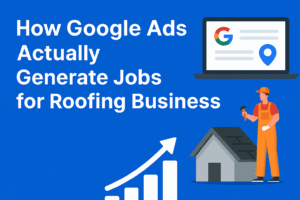
Most roofing business owners get Google Ads wrong. They think: throw budget at search terms and the phones will ring — and that’s success. But phone calls and form submissions don’t pay your bills.
Closed roofing jobs — roof repairs, full roof replacements, storm-restoration projects, commercial re-roofs, insurance-claim work — are what actually generate revenue. To judge whether Google Ads are profitable for your roofing company you must calculate revenue after materials, labor, travel, permit costs, insurance coordination fees, and ad spend. Only then can you tell if ads are producing real profit.
Below I show how to make Google Ads deliver roofing jobs, not just leads. I reuse the same four-pillar system I use for HVAC — adapted for residential and commercial roofing.
Pillar 1: Attract High-Intent Roofing Leads with Targeted Traffic
Your ads must pull in buyers — homeowners or property managers who are ready to hire a roofer — not DIYers, price-shopping tire-kickers, or leads outside your service area.
What quality & relevant traffic looks like for roofing
- Quality traffic: People ready to schedule an inspection, file an insurance claim, or hire for a replacement or emergency repair.
- Relevant traffic: People in your service area (city/zip/county) searching for roofing services you offer (residential or commercial).
If someone searches “roof leak repair near me” — you should appear. If they search “how to replace shingles myself” — you should not. If you service two counties but ad clicks come from the other side of the state, that traffic is worthless.
Your job is to control who clicks — because only the right clicks become paid roofing jobs.
How to do it (practical checklist)
- Build an intent-first keyword list: e.g., “roof replacement near me”, “hail damage roofers”, “commercial roof membrane repair”, “emergency tarp roof”.
- Add aggressive negative keywords: block DIY, how to, tutorial, cheap, free, materials price, cheap shingles, shingles store.
- Use match types strategically: exact & phrase for high-intent queries; avoid broad unless you have strict negatives and query monitoring.
- Geo-target tightly: city, ZIP, county, or radius — exclude areas you don’t serve (and exclude known low-value ZIPs).
- Schedule ads for when you can take calls and schedule inspections (include weekends if your estimators work them).
- Use call-only campaigns and call extensions for mobile-first callers; use location extensions to show you’re local and insured.
- Set higher bids for emergency- and claim-intent queries (e.g., “storm damage roof inspection”, “leak emergency roof”).
- Create separate campaigns for residential vs commercial so bidding, messaging, and landing pages match intent.
- Monitor search queries daily at first — add negatives and pause queries that bring junk traffic.
- Track the right KPIs: CPC → CPL → Cost per Booked Job (CPBJ) and Cost per Closed Job (include job value buckets).
Pillar 2: Post-Click Optimization (Landing Page That Converts to Booked Jobs)
Clicks are cheap; the landing page decides whether the visitor becomes a qualified lead that your team can turn into a paid job.
What a roofing landing page must do
- Prove you’re local and credible (licenses, insurance, manufacturer certifications).
- Show your service scope clearly: residential, commercial, storm restoration, insurance claims assistance.
- Ask the right qualifying questions so you attract people willing to pay for inspection, estimates, and work.
- Make it dead-simple to request an inspection or upload photos of damage.
How to build it
Above the fold
- Headline: “Emergency Roof Repair & Full Roof Replacement — [City/County]”
- Prominent local phone number and single CTA: Call Now / Book Free Roof Inspection
- Trust badges: contractor license, insurance, GAF/IKO/CertainTeed certification, Better Business Bureau, photos of crew/van.
Qualification & conversion elements
- Short form (3 fields): Address/ZIP, Issue (leak, storm damage, replacement), Preferred time + optional photo upload (mobile-friendly).
- Mention service types and minimum project sizes if needed (e.g., “We handle residential and commercial jobs $2,000+” to deter tiny jobs).
- Offer insurance assistance: “We work with your insurer — free storm-inspection & claim support” — this appeals to homeowners after storms.
- Portfolio: before/after photos, case studies, storm-season gallery, commercial projects.
- Social proof: local reviews, Google star rating, short testimonial snippets (name + city).
- Clear next steps: “We inspect → provide estimate → coordinate with insurance → schedule work”.
- Mobile-first 1-tap call button; make uploading photos + address painless.
Optional but powerful
- A simple price hint or financing note: “Roof replacements from $X — financing available” to filter low-ball shoppers.
- A “Book Estimator” calendar widget for qualified traffic (only if you can honor appointment windows).
A landing page that qualifies visitors will drastically increase the percentage of leads that become booked roofing jobs.
Pillar 3: Lead Management & Job Conversion
Getting the lead is just step one — converting it into a paid roofing job is where profit lives.
Key focus areas
- Speed to contact: reach out ASAP. For storm-damage leads or leaks, response time is a major differentiator.
- Qualification: separate emergency/insurance claims/high-value replacement leads from small handyman requests.
- Follow-up process: schedule inspections, send reminders, confirm appointments, and follow through on estimates.
- Sales training: teach estimators how to spot upsell/upgrade opportunities (materials, ventilation, guttering) and how to explain warranties and insurance workflows.
How to run it
- Use a roofing-friendly CRM (e.g., JobNimbus, AccuLynx, ServiceTitan) or a structured lead-log that tags lead source, job type, estimated job value, insurance-involved Y/N.
- Triage leads: high-value / insurance claims / emergency repairs get highest-priority callbacks and in-person inspections within 24 hours.
- Assign an estimator or project manager to every qualified lead — ownership increases closure rates.
- Track conversion funnels: lead → scheduled inspection → estimate → booked job → closed job (include reasons lost).
- Follow-up cadence: immediate call + SMS, same-day follow-up, 48-hour reminder, and a 7–10 day nurture for hesitant leads.
- Train crews on estimate presentation (photos, damage explanation, scope-of-work, warranty benefits) so homeowners understand the value beyond price.
Pillar 4: Feed Closed-Job Data Back to Google (Offline Conversion Tracking)
Google optimizes for what you tell it to optimize. If your account only reports leads, Smart Bidding will deliver more leads — not more closed roofing jobs.
How to make Google optimize for jobs
- Track when a lead becomes a closed roofing job (booked and completed, or at least booked with deposit/contract).
- Upload those closed-job conversions into Google Ads as offline conversions.
- Mark closed-job conversions as Primary in Google Ads so Smart Bidding optimizes toward high-value jobs.
- You can use a CRM to automate the upload or a simple CSV/spreadsheet upload on a schedule — a CRM is not strictly required but automates and scales better.
What to feed back
- Lead ID, conversion time, conversion value (optional but powerful), job type (repair, replacement, commercial), and whether it was insurance-backed.
- Even partial feedback (booked job with deposit) is far better than only tracking raw leads.
Result: over time Google learns which queries, keywords, and creatives are associated with real paid roofing jobs and will shift budget toward those searchers.
A step-by-step offline-conversion walkthrough is coming soon.
Final Breakdown — How to Turn Google Ads Into a Roofing Job Machine
- Attract quality & relevant traffic (residential & commercial).
- Convert clicks with a landing page that pre-qualifies and makes scheduling/inspection easy.
- Manage leads to convert them into paid roofing jobs — fast response, trained estimators, and an organized CRM.
- Feed closed-job data back to Google Ads so Smart Bidding learns to find customers who actually pay.
When these four pillars work together, Google Ads stop being a “lead-gen” checkbox. They become a predictable source of booked roofing jobs and revenue — whether it’s a $600 emergency leak or a $30,000 commercial re-roof.